AI is no longer optional. It is no longer experimental. And it is no longer confined to technical teams.
Across logistics, transportation, and service-based industries, leaders are under pressure to adopt artificial intelligence quickly. New tools promise efficiency, automation, and competitive advantage. Platforms arrive with polished demos and bold claims. Internal teams ask which software to buy next.
What almost no one pauses to ask is the most important question.
What decisions is AI supposed to improve here?
That single question is the difference between AI strategy and AI tools. Confusing the two is one of the most expensive mistakes modern leaders are making.
Executive Summary
AI strategy and AI tools are not the same thing. AI tools execute tasks, while AI strategy defines which business decisions intelligence should support. Most organizations struggle with AI because they invest in tools before clarifying decision ownership, business priorities, and data inputs. Companies that lead with AI strategy see stronger ROI, higher adoption, and more consistent outcomes than those focused on technology alone.
The moment the industry is in right now
AI has crossed a threshold. It is no longer about whether companies should use it. It is about how well leaders understand what they are actually implementing.
In logistics and transportation, AI touches recruiting, safety, dispatch, pricing, customer communication, marketing, and forecasting all at once. In service-based businesses, AI influences lead generation, sales operations, delivery, and client retention simultaneously.
This creates urgency, but it also creates risk.
When pressure rises, leaders tend to reach for tools. Software feels tangible. Strategy feels abstract. Buying a platform looks like progress. Clarifying decisions feels slower.
But speed without direction does not produce transformation. It produces motion.
AI strategy is not the same as AI adoption. And AI adoption without strategy is where most initiatives quietly stall.
What is the difference between AI strategy and AI tools?
AI strategy defines how leadership uses intelligence to improve business decisions. AI tools are technologies that execute tasks or automate workflows. Strategy determines where AI should influence revenue, operations, risk, or growth. Tools support that strategy but do not replace it.
AI strategy answers questions about direction, priorities, and accountability. AI tools answer questions about execution and efficiency.
When organizations confuse the two, they automate activity without improving outcomes. When strategy leads, tools become force multipliers instead of distractions.
This distinction is critical because most business outcomes are driven by decisions, not tasks. Hiring decisions. Pricing decisions. Routing decisions. Messaging decisions. Risk decisions.
AI can accelerate the work around those decisions, but it cannot define what a good decision looks like. That responsibility remains with leadership.
Why AI tools alone do not create business value
AI tools increase speed and scale. They do not define success.
Many AI initiatives do not fail because the technology is flawed. They fail before they ever reach execution because leadership skips the strategy layer entirely. When decisions are unclear, priorities are misaligned, and ownership is undefined, AI tools simply accelerate confusion. This pattern is explored more deeply in our breakdown of why most AI initiatives fail before they start and what strategic leaders do differently, which shows how decision-first leadership separates successful AI transformations from stalled pilots.
Without strategy, AI systems optimize whatever inputs they are given, even if those inputs reflect poor assumptions or unclear goals. Automation without clarity simply makes inefficiency happen faster.
McKinsey’s research on AI transformation consistently shows that organizations achieving real value from AI focus first on business use cases tied to decision-making and value creation, not on technology deployment alone.
AI does not fix broken systems. It exposes them.
This is why so many AI initiatives look impressive during pilots and then quietly fade. The tools worked. The strategy never existed.
How confusion shows up inside real organizations
The confusion between AI strategy and AI tools rarely announces itself clearly. It shows up in patterns leaders often normalize.
Recruiting teams invest in AI sourcing and screening platforms, only to see applicant volume rise while placement quality declines. The algorithm did exactly what it was designed to do. It increased outreach. What was never defined was what “qualified” truly meant for the business.
Marketing teams deploy AI content tools to publish faster, yet engagement and conversion drop. Content output increases, but buyer clarity decreases. The issue is not the writing. It is the absence of a strategy tied to intent and revenue decisions.
Operations teams implement AI dashboards that surface insights in real time, but nothing changes operationally. Alerts fire. Reports update. No one acts. Decision ownership was never defined.
Customer service departments automate responses to reduce costs, only to erode trust. AI replaces judgment instead of supporting it. Escalation rules are unclear. Human handoff becomes an afterthought.
In every case, the tool performed. The strategy was missing.
Why this matters more in logistics and service industries
In high-margin technology companies, inefficient AI use may slow growth. In logistics and service-based businesses, it can damage operations, safety, and client relationships.
These industries depend on coordination, trust, and timing. Decisions ripple quickly. A small error in recruiting affects retention. A delay in operational insight impacts service delivery. A misaligned message affects credibility.
AI amplifies these dynamics.
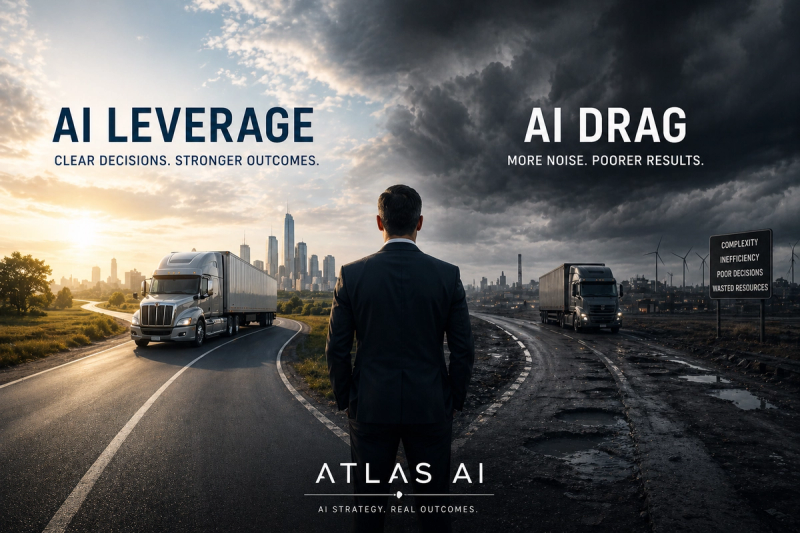
When strategy leads, AI strengthens execution. When tools lead, AI magnifies weaknesses.
This is why AI must be treated as a decision-support capability, not a collection of features.
What the data says about AI ROI
Gartner emphasizes that AI value comes from decision-centric design rather than technology accumulation. Organizations that operationalize AI around decision-making, governance, and accountability outperform those that treat AI as isolated software investments.
Harvard Business Review reinforces this point, noting that many AI initiatives fail because companies automate existing processes without rethinking how decisions are made. AI succeeds when leaders redesign workflows around judgment, not just efficiency.
Across industries, the conclusion is consistent.
AI improves speed.
Strategy improves direction.
Sustainable ROI requires both.
The leadership fears driving tool-first behavior
Most leaders do not skip strategy intentionally. They are responding to pressure.
They fear falling behind competitors who appear more advanced.
They assume AI strategy requires technical expertise their teams lack.
They feel locked into tools already purchased.
They worry AI will replace people and create internal resistance.
None of these fears are solved by buying more software.
AI strategy is not a technical exercise. It is a leadership one. It focuses on decisions, not code. In many cases, organizations already own the right tools. They simply lack the framework to use them effectively.
A decision-first approach to AI strategy
At Atlas AI, AI strategy begins with leadership clarity.
The first step is identifying which decisions most directly impact growth, retention, safety, or risk. These are moments where better judgment changes outcomes.
Next comes understanding what information feeds those decisions. What data exists. What is missing. What is noisy or misleading.
Decision ownership must then be defined. When AI surfaces insight, someone must be accountable for acting on it. Without ownership, intelligence becomes passive.
Only after this clarity exists do tools matter. At that point, selecting AI systems becomes easier because the criteria are clear. The tool must support a specific decision flow, not a generic function.
Finally, adoption and trust are built through feedback loops. Teams learn when to rely on AI, when to challenge it, and when to escalate to human judgment.
This is how AI becomes embedded into the business instead of layered on top of it.
How this approach changes outcomes
When AI strategy leads, recruiting systems prioritize fit instead of volume. Marketing systems prioritize intent instead of output. Operations systems prioritize action instead of reporting.
AI stops being something the company uses and starts becoming something the company relies on intelligently.
Teams gain confidence because expectations are clear. Leaders gain visibility because decisions are traceable. Customers feel the difference because execution improves.
Most importantly, AI investments begin to compound instead of stall.
The core takeaway for leaders
AI does not fail because the technology is immature. It fails because leadership skips the strategy layer.
Organizations that treat AI as a decision-support system outperform those that treat it as software to install.
Tools execute. Strategy decides.
AI does not replace leadership. It reveals it.
Common questions leaders ask about AI strategy
Is AI strategy only for large enterprises?
No. AI strategy matters even more for small and mid-sized organizations because resources are limited. Clear priorities prevent wasted spend and stalled pilots.
Do we need new tools to create an AI strategy?
No. Strategy comes first. Many organizations already own the right tools but lack clarity on how to use them effectively.
Can AI strategy exist without technical expertise?
Yes. AI strategy is a leadership function. It focuses on decisions, not coding.
Why do AI projects fail after early pilots?
Most fail because decision ownership and process redesign were never defined. Tools were deployed without accountability.
Ready to lead with clarity instead of chaos?
If you are investing in AI but still feel unsure which decisions it is supposed to improve, that is the gap worth addressing first.
A short strategy conversation can clarify where AI belongs in your business and where it does not.
Schedule a 15 -minute discovery call.