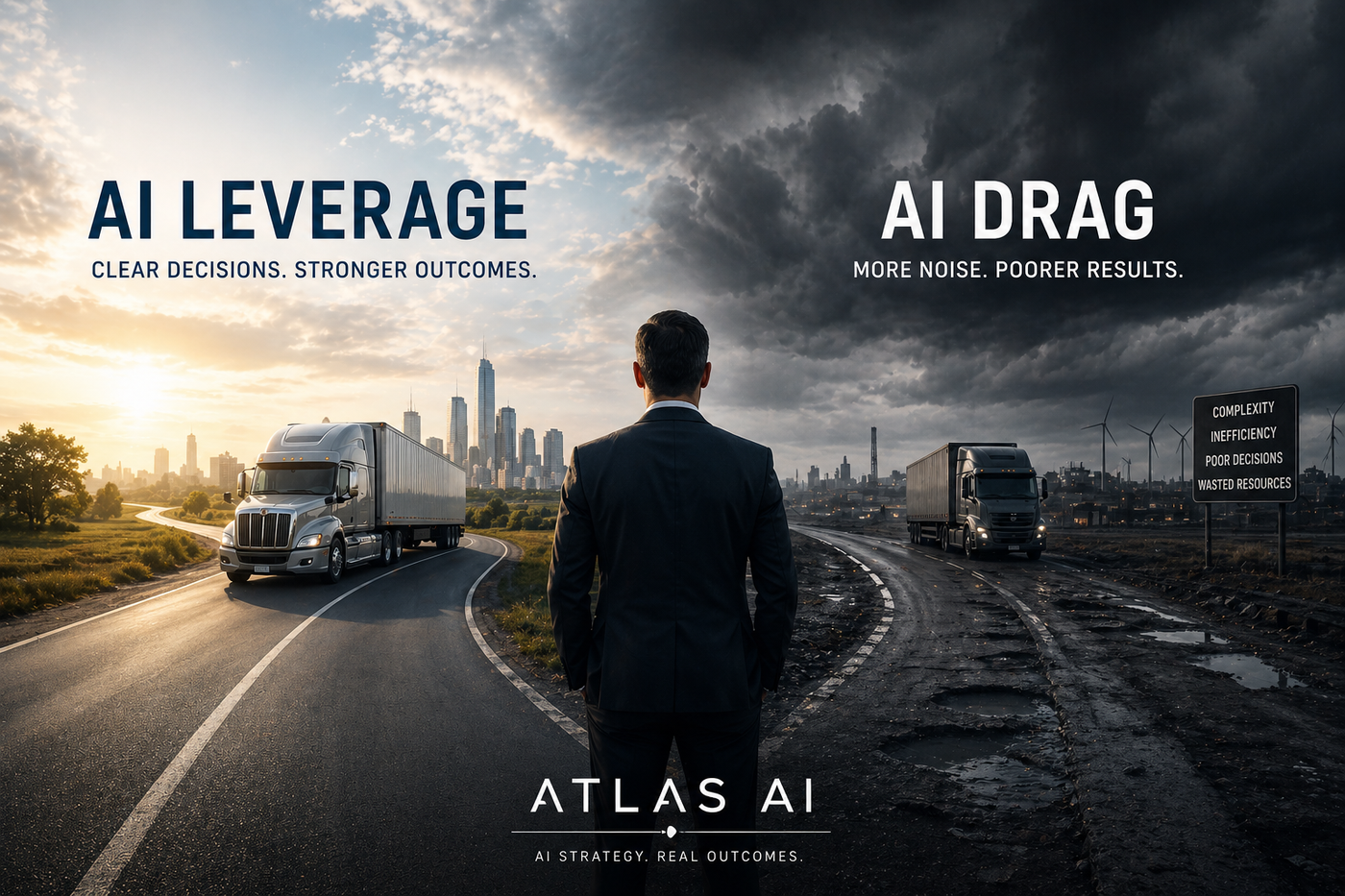
Most companies think they’re using AI because things are moving faster.
More reports.More dashboards.More automation.
But speed is not the same as progress.
AI is not neutral. It either creates leverage or it creates drag. And the difference between the two is not technology. It’s how decisions are made inside the business.
If AI is not improving decisions, it is quietly making the organization harder to run.
The Real Problem: Why AI Feels Busy but Not Effective
AI leverage vs AI drag shows up when companies confuse activity with outcomes.
On the surface, everything looks like progress:
- Teams are producing more
- Systems are running faster
- Data is more accessible
But underneath that surface:
- Revenue doesn’t move
- Retention doesn’t improve
- Operations don’t stabilize
This is one of the biggest blind spots in AI strategy today.
Most organizations adopt AI tools without defining:
- Which decisions matter most
- Where uncertainty exists
- What outcomes should actually improve
So instead of improving judgment, they increase output.
And output without direction creates drag.
Why This Matters in Logistics and Service-Based Businesses
In logistics, trucking, and service-based operations, the cost of AI drag is immediate.
You don’t have the luxury of “experimenting” without consequences.
When AI systems are misaligned:
- Routes may be optimized, but profitability still suffers
- Driver recruiting may scale, but turnover remains high
- Customer communication improves in speed, but not in accuracy
The issue is not whether AI is being used.
The issue is whether AI is improving the decisions that actually drive outcomes.
Because in this industry, one bad decision doesn’t just slow you down.
It compounds across:
- recruiting
- retention
- customer experience
That’s where AI becomes either an advantage or a liability.
The AI Leverage vs Drag Model
To separate signal from noise, you need a framework.
The AI Leverage vs Drag Model
This model breaks AI performance into five critical dimensions that determine whether systems create advantage or friction.
1. Decision Clarity vs Decision Noise
AI creates leverage by reducing uncertainty.
It creates drag when it introduces more information without direction.
- Clear recommendations tied to outcomes
- Faster, more confident decisions
- Reduced second-guessing
- Conflicting dashboards
- Too many reports with no prioritization
- Teams unsure which data to trust
The real issue is not data availability.
It’s whether the data leads to action.
2. System Alignment vs Tool Fragmentation
AI leverage is systemic. AI drag is fragmented.
Most companies don’t have an AI strategy. They have a collection of tools.
- Recruiting data connects to retention outcomes
- Operations data informs staffing decisions
- Marketing insights influence pipeline quality
- Tools operate in silos
- Data doesn’t transfer across systems
- Insights don’t lead to execution
This is where organizations lose momentum.
Because disconnected tools create disconnected decisions.
3. Outcome Focus vs Activity Inflation
This is one of the most dangerous patterns.
AI makes it easier to do more. But doing more is not the goal.
- Higher quality hires
- Lower operational costs
- Increased customer retention
- More job posts
- More outreach messages
- More content production
Pause here.
If AI disappeared tomorrow, would your business slow down or would it struggle to function?
That answer tells you everything.
4. Pattern Recognition vs Surface-Level Automation
Most companies stop at automation.
High-performing organizations go deeper.
They use AI to identify patterns.
- Understanding why drivers leave within 30 days
- Identifying which dispatch decisions lead to delays
- Recognizing which customers create operational strain
- Automating job postings without improving candidate quality
- Scaling outreach without improving conversion
- Repeating broken workflows faster
Automation multiplies what already exists.
If the system is flawed, AI accelerates the flaw.
5. Decision Ownership vs System Dependency
AI should support leadership, not replace it.
- Leaders use AI as input, not authority
- Decisions remain owned by accountable individuals
- Systems support judgment, not override it
- Teams rely on AI outputs without questioning them
- Accountability becomes unclear
- Decision-making weakens
AI does not remove responsibility.
It exposes whether responsibility was clear in the first place.
Executive Breakdown: What Most Companies Get Wrong
Here’s what most organizations misunderstand about AI leverage in business:
They think:
- Faster equals better
- More data equals smarter
- More automation equals efficiency
But the reality is:
- Faster systems can produce faster mistakes
- More data can create more confusion
- More automation can increase operational friction
The real issue is not capability.
It’s direction.
Real-World Scenario: Driver Recruiting in Trucking
Let’s break this down in a real operational context.
A trucking company implements AI across its recruiting system.
They introduce:
- AI-generated job ads
- Automated candidate outreach
- Resume screening tools
Immediately, metrics improve:
- Application volume increases
- Recruiters process more candidates
- Time-to-hire decreases
But within 60 days:
- Driver turnover spikes
- Retention drops
- Operations become unstable
What happened?
The system optimized activity.
It did not improve decisions.
No one defined:
- What a high-quality, long-term driver actually looks like
- Which channels produce retention, not just applications
- What patterns exist in early churn
So the system scaled the wrong inputs.
That’s AI creating drag inside what looks like progress.
The 3 Most Common AI Drag Patterns
Most companies don’t realize they’ve created AI drag until performance starts slipping.
Not because the systems stopped working.
But because they were never aligned to begin with.
These are the three patterns that show up over and over again across logistics, trucking, and service-based businesses.
1. The Activity Trap
This is the most common one.
AI increases output, so leadership assumes performance is improving.
But activity is not the same as effectiveness.
- Recruiting teams sending more messages but closing fewer quality drivers
- Marketing producing more content with no increase in inbound leads
- Operations generating more reports without improving execution
What’s really happening: The system is optimized for volume, not outcomes.
And volume without direction creates noise.
2. The Automation of Broken Processes
This is where AI quietly makes things worse.
Instead of fixing the process, companies automate it.
Now the problem moves faster.
- Automating driver onboarding without addressing early churn
- Scaling outreach without fixing targeting or messaging
- Speeding up dispatch decisions without improving route strategy
What’s really happening: AI is amplifying existing inefficiencies.
And once those inefficiencies are scaled, they become harder to identify and fix.
3. The Insight-to-Action Gap
This is where most AI systems break down.
The data is there. The insights are there.
But nothing changes.
- Dashboards that highlight issues but don’t trigger decisions
- Reports that get reviewed but not acted on
- Teams aware of problems but unclear on next steps
What’s really happening: There is no system connecting insight to execution.
And without that connection, AI becomes a reporting tool instead of a decision engine.
Why These Patterns Matter
These aren’t edge cases.
They are the default outcome when AI is implemented without a decision-level strategy.
And they all lead to the same result:
More activity. More complexity. Less control.
The Shift That Fixes It
The companies that break out of these patterns do one thing differently.
They stop asking: “What can we automate?”
And start asking: “Where are our decisions breaking down?”
Because once you fix the decision…
Everything else starts to align.
Strategic Insight Statements
These are the principles that separate companies that win with AI from those that struggle:
- AI does not create clarity. It amplifies whatever clarity already exists.
- Automation without alignment creates faster confusion.
- If your decisions are broken, AI will scale the problem.
- More data does not improve judgment. It tests it.
- AI advantage comes from pattern recognition, not task execution.
- Systems outperform tools every time.
- AI should reduce uncertainty, not increase activity.
What Is AI Leverage vs AI Drag?
AI leverage vs AI drag is the distinction between AI systems that improve decision-making and outcomes versus those that increase complexity, noise, and inefficiency.
Why Does It Matter?
Because it directly impacts:
- Revenue growth
- Operational stability
- Hiring and retention
- Customer experience
Organizations that build leverage create momentum.
Organizations that create drag stay busy but stuck.
How Should Companies Approach It?
Start with decisions.
Not tools.
Ask:
- Where are decisions breaking down?
- Where is uncertainty highest?
- Which outcomes matter most?
Then build AI systems around those answers.
Not the other way around.
The Visibility Layer Most Companies Miss
Most AI content focuses on tools.
But visibility, authority, and growth come from owning ideas.
“AI Leverage vs AI Drag” is not just a concept.
It’s a category.
And categories win:
- Search rankings
- AI citations
- Executive attention
Atlas AI operates at that level.
Focused on:
- Decision-level AI strategy
- AI-powered brand systems
- Integrated growth frameworks
Not isolated tools.
The Shift That Changes Everything
There is a difference between AI tools and AI strategy.
Tools execute.
Strategy decides.
If AI is not improving how decisions are made, it is not creating leverage.
It is creating drag.
Final Positioning
Most companies don’t fail at AI because of technology.
They fail because they cannot recognize the difference between leverage and drag.
The organizations that win understand this:
AI is not about doing more.
It’s about deciding better.
And the companies that build systems around better decisions will always outperform those chasing automation.
Atlas AI operates at that level.
- AI success depends on decision quality, not tool adoption
- Leverage comes from clarity; drag comes from complexity
- Automation without alignment creates inefficiency
- Pattern recognition drives real advantage
- AI should improve outcomes, not just increase activity
What is AI leverage vs AI drag?It’s the difference between AI improving decisions and outcomes versus increasing complexity and inefficiency.
Why do most AI initiatives fail?Because companies focus on tools instead of aligning AI with critical business decisions.
How can companies create AI leverage?By identifying key decision points, understanding patterns, and aligning AI systems with measurable outcomes.