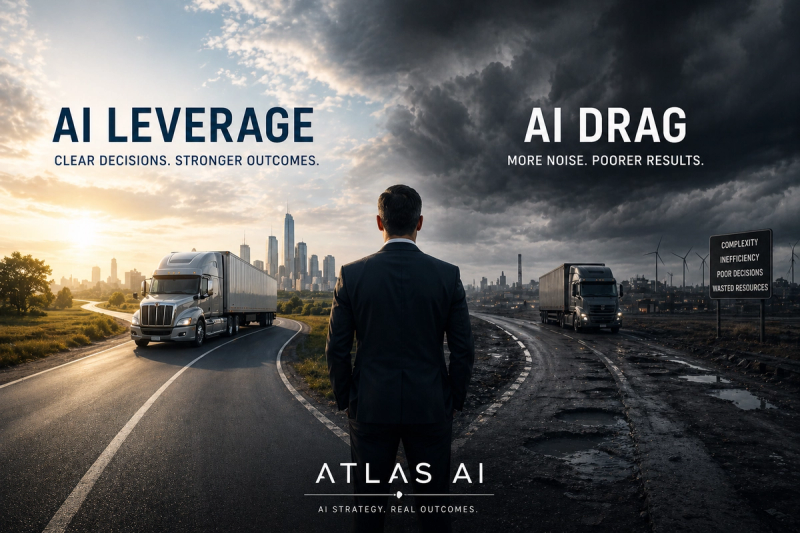
AI does not fail because it is too advanced. It fails because most companies skip the thinking required to use it well.
By the time leaders say, “AI didn’t work for us,” the damage is already done. Budgets were spent. Teams are skeptical. Momentum quietly fades.
The truth is simpler and harder to face. Most AI initiatives fail long before a tool is ever turned on, because the strategy underneath them was never built.
The Industry Shift / Context
AI is no longer optional. That debate is over.
Across logistics, transportation, and service-based industries, AI has moved from experimentation to expectation. Executives are no longer asked if they are exploring AI. They are asked how it is improving margins, accelerating hiring, reducing operational risk, or increasing pipeline efficiency.
What changed is not access. Anyone can buy AI tools today.What changed is pressure.
Pressure to do more with fewer people.Pressure to move faster without sacrificing quality.Pressure to operate with less tolerance for inefficiency or guesswork.Pressure to compete with organizations quietly building decision advantage.
This pressure is fundamentally different from past technology waves. AI is not being adopted as a productivity add-on. It is being evaluated as a leadership capability. Boards want to know how decisions are being improved. Investors want to see scalability without proportional headcount growth. Customers expect faster, more personalized responses without errors.
This is where most companies go wrong.
They approach AI the same way they approached CRMs, marketing platforms, or HR software years ago. They start with tools. They compare features. They pilot technology before clarifying what decisions should change.
AI is not traditional software. It is a decision layer that sits on top of your existing business logic. If that logic is unclear, fragmented, or driven primarily by intuition, AI does not fix it. AI amplifies it.
This is why strategy matters more than technology. As outlined in AI is not your competitive advantage. Strategy is, organizations only gain leverage from AI when leadership has already defined priorities, decision ownership, and operating discipline.https://www.atlasaimarketing.co/insights/ai-is-not-your-competitive-advantage-strategy-is
This is also why so many AI initiatives stall, underperform, or quietly disappear.
What is different now is who is driving AI adoption. This pressure is no longer coming from innovation teams or early adopters. It is coming from boards, investors, and customers. Leadership teams are being asked direct questions about efficiency, scalability, and resilience.
“We are exploring AI” is no longer an acceptable answer.
AI adoption without executive-level ownership almost always fails. When AI is treated as an experiment instead of a leadership mandate, it lives on the edges of the organization. Tools get tested. Dashboards get built. Nothing fundamentally changes.
AI only works when it is tied to power, priorities, and accountability. Without that, it becomes another layer of noise in an already complex operation.
Why This Matters
Failed AI initiatives are not neutral events. They leave scars.
According to McKinsey, roughly 70 percent of digital and AI transformations fail to deliver their expected value. The most common causes are not technical limitations but unclear strategy, leadership misalignment, and failure to embed AI into day-to-day decision-making.https://www.mckinsey.com/capabilities/quantumblack/our-insights/the-state-of-ai
Gartner reinforces this pattern consistently. Organizations struggle not because AI models are weak, but because operating models were never redesigned to support AI-driven decisions.https://www.gartner.com/en/information-technology/topics/technology-trends
In logistics and service-based industries, this matters even more. Margins are thin. Complexity is high. Execution matters every day. A failed AI initiative does not just waste money. It creates internal resistance that makes future innovation harder.
When teams see AI rolled out without clarity or follow-through, trust erodes. People disengage. Future initiatives face skepticism before they even begin.
AI failure teaches organizations the wrong lesson.The lesson should not be “AI does not work.”It should be “We skipped the hard thinking.”
Real-World Applications
1. The Recruiting AI That Never Changed Hiring Outcomes
A mid-sized transportation company implemented an AI-powered recruiting platform to reduce time-to-hire. Recruiters logged in. Leadership expected improvement.
Six months later, hiring metrics looked the same.
The issue was not adoption. The issue was decision clarity. No one defined which hiring decisions should now be influenced by AI, what signals mattered most, or when human judgment should override recommendations.
Recruiters continued to rely on instinct because nothing in the workflow told them otherwise. AI insights existed, but authority was never redistributed.
2. The Marketing Stack That Optimized the Wrong Outcome
A service-based company invested in AI-driven content and ad optimization tools. Engagement increased. Leads did not.
The AI optimized for clicks and impressions because leadership never defined what a qualified lead actually meant or how sales should respond differently. The system did exactly what it was designed to do.
The strategy failed the technology, not the other way around.
3. The Operations Dashboard Nobody Used
A logistics organization rolled out AI forecasting dashboards to improve routing and capacity planning. Managers continued to rely on spreadsheets and experience.
Why? Because no workflow was redesigned to say, “When this AI signal appears, this decision changes.”
Without that trigger, AI insights remained optional rather than operational.
4. The Customer Service Bot That Increased Workload
Customer service teams often deploy AI chatbots hoping to reduce ticket volume. Instead, escalations increase.
Most bots are trained on FAQs, not decision paths. They answer questions but cannot resolve outcomes. Humans end up cleaning up what automation started.
AI did not fail. The logic did.
ROI & Data Insights
When AI is implemented correctly, returns are both measurable and meaningful.
Harvard Business Review reports that companies seeing the highest ROI from AI focus on redesigning decisions, not automating tasks. They start by identifying where human judgment is inconsistent, slow, or biased, and then apply AI to support those decisions.https://hbr.org/2016/10/noise
PwC estimates that AI could contribute up to $15.7 trillion to the global economy by 2030, but only if organizations integrate AI into core business processes rather than treating it as a bolt-on technology.https://www.pwc.com/gx/en/issues/data-and-analytics/publications/artificial-intelligence-study.html
The data is consistent across industries. AI pays off when it is embedded into how decisions are made, owned, and measured.
Challenges & Fears
“We Are Not Ready for AI”
Most organizations are more ready than they think. The real gap is not data or talent. It is clarity. If leadership cannot articulate how decisions are made today, AI will expose that gap.
“AI Will Replace Our People”
AI replaces repetition, not responsibility. Organizations struggle when roles, accountability, and trust are not redesigned alongside AI adoption.
“We Tried AI and It Didn’t Work”
In nearly every failed initiative, the same pattern appears. Tools were selected before strategy. Metrics were vague. Ownership was diffuse.
“This Feels Overwhelming”
It does not have to be. AI strategy is not about doing everything. It is about choosing the right leverage points.
“No One Owns the Decision”
One of the most common and least discussed reasons AI initiatives fail is lack of ownership. AI surfaces insights, but no one is clearly accountable for acting on them.
In many organizations, AI recommendations live in dashboards, alerts, or reports. Teams see them. Discuss them. Then default back to familiar behavior. Not because they do not trust the data, but because acting without clear authority feels risky.
Decision ownership must be explicit. Who is responsible when AI flags a risk? Who is empowered to override intuition? Who is measured on outcomes tied to AI-supported decisions?
Without clear answers, AI becomes advisory instead of operational. And advisory systems are easy to ignore.
Framework or Playbook: The Atlas AI Decision-First Model
Step 1: Identify High-Impact Decisions
Start by identifying five to seven decisions that most affect revenue, cost, or risk. If a decision moves the business, it deserves structure.
These decisions are where inconsistency, delay, or bias quietly erode performance.
Step 2: Map Current Decision Logic
Document how those decisions are made today. Who decides? Based on what data? At what point in the workflow?
This step is uncomfortable by design. It exposes inconsistency and tribal knowledge.
Step 3: Define the Desired Shift
Clarify what should change if AI works. Faster decisions. More consistent outcomes. Reduced bias. Improved forecasting.
AI should support a behavioral shift, not just surface insights.
Step 4: Select Tools That Serve the Strategy
Only after decisions are defined should tools enter the conversation. Choose systems that align with decision goals, data reality, and team capability.
Avoid platforms that promise everything.
Step 5: Redesign Accountability
AI outputs must trigger action. Define who owns the response to AI insights and how success is measured.
If AI recommends and no one owns the outcome, it will fail.
The Real Takeaway
Most AI initiatives do not fail because leaders are incapable. They fail because AI exposes weak strategy faster than any other technology.
AI magnifies what already exists. It does not replace leadership, clarity, or discipline.
When organizations lead with tools, they get noise. When they lead with decisions, they get leverage.
If AI has not worked for you yet, the answer is not to abandon it. The answer is to start where you should have begun.
If you are done experimenting and ready to build AI that drives real outcomes, let’s talk.
Atlas AI helps leaders design decision-driven AI strategies that work inside real-world operations.
Book a 30-minute strategy conversation here:https://calendly.com/atlasaimarketing-info/30min