Most companies believe they are becoming AI-ready because they are moving faster.
More dashboards.More automation. More AI tools layered into workflows.
On the surface, it looks like progress.
But if outcomes are not improving, it is not readiness. It is activity.
AI readiness for business has nothing to do with how much technology you’ve adopted. It has everything to do with whether your business understands where its decisions are breaking down and how to improve them.
That is the shift most leaders are still missing.
What AI Readiness Actually Means
AI readiness for business is the ability to consistently make better decisions by aligning data, systems, and leadership around the moments that impact outcomes.
That definition matters because it reframes the entire conversation.
AI readiness is not:
- Having the latest tools
- Building complex data infrastructure
- Hiring technical teams without direction
AI readiness is:
- Knowing which decisions drive revenue, cost, and growth
- Identifying where those decisions fail or rely on guesswork
- Using intelligence, including AI, to reduce uncertainty and improve judgment
This is why many organizations feel like they are “doing AI” but not seeing results.
They are optimizing activity instead of improving decisions.
And AI does not reward activity. It rewards clarity.
The Industry Shift: From Automation to Decision Intelligence
The first wave of AI adoption was centered around automation.
Companies asked:
- What can we automate next?
- How do we move faster?
- How do we reduce manual work?
That led to:
- Automated workflows
- AI-generated content
- Faster reporting
But it did not necessarily lead to better outcomes.
Now we are entering a second wave.
This wave is not about automation. It is about decision intelligence.
Leaders are beginning to ask:
- Where are we making the wrong calls?
- Where are we guessing instead of knowing?
- What decisions are costing us money?
This shift is critical.
Because automation increases output.Decision intelligence improves results.
According to a report from McKinsey & Company, organizations that embed AI into decision-making processes, not just operational tasks, see significantly higher performance improvements. You can explore their findings here: https://www.mckinsey.com/capabilities/quantumblack/our-insights/the-state-of-ai
That is the dividing line.
Companies that stay in the automation layer will plateau.Companies that move into decision intelligence will compound.
AI Readiness vs AI Maturity
One of the biggest misconceptions in the market today is the idea of AI maturity.
Most frameworks define maturity based on:
- Data infrastructure
- Technology adoption
- Integration complexity
- Organizational capability
On paper, that sounds logical.
But it creates a false signal.
It suggests that the more advanced your technology stack becomes, the more “ready” you are.
That is not how real businesses operate.
A company can be highly “mature” in its AI infrastructure and still:
- Hire the wrong people
- Waste marketing spend
- Miss operational inefficiencies
- Struggle with retention
Because their decisions are still inconsistent.
AI readiness is different.
It is not about how advanced your systems are.It is about how effective your decisions are.
You can be early in your AI journey and still be highly AI-ready if:
- Your decisions are clearly defined
- Your data supports those decisions
- Your systems are aligned to improve them
Clarity scales faster than complexity.
And clarity is what AI systems actually amplify.
Why This Matters for Business Performance
AI is often framed as a technology upgrade.
In reality, it is a decision-making upgrade.
That distinction directly impacts:
- Revenue growth
- Cost efficiency
- Hiring quality
- Customer experience
- Operational performance
Research from MIT Sloan Management Review reinforces this point. Organizations that apply AI to decision-making, rather than just automation, are significantly more likely to capture real business value. Source:https://sloanreview.mit.edu/article/intelligent-choices-reshape-decision-making-and-productivity/
Here is what that looks like in practice:
When AI improves decisions:
- Marketing spend becomes more precise
- Hiring becomes more predictable
- Operations become more efficient
- Risk becomes more manageable
When AI only automates tasks:
- You get more output
- But not necessarily better results
That is why so many AI initiatives stall.
They create movement, not improvement.
Real-World Applications of AI Readiness
AI readiness shows up in how decisions are made across the business.
Not in the tools being used.
1. Recruiting Decisions
Before AI readiness:Hiring is reactive. Decisions are based on urgency, incomplete information, and intuition.
After AI readiness:Recruiting is structured. Data and AI insights help identify which candidates are most likely to succeed, stay, and perform.
Impact:
- Lower turnover
- Better cultural fit
- Stronger onboarding outcomes
2. Marketing Investment Decisions
Before AI readiness:Marketing budgets are allocated based on past campaigns or assumptions.
After AI readiness:AI analyzes performance patterns and predicts which channels, messages, and audiences will convert.
Impact:
- Higher ROI
- Reduced wasted spend
- Clear attribution
3. Operational and Routing Decisions
Before AI readiness:Routing decisions are reactive and inconsistent.
After AI readiness:AI predicts delays, optimizes routes, and improves planning accuracy.
Impact:
- Reduced costs
- Increased efficiency
- Better service delivery
Industry insights from FreightWaves highlight how predictive analytics is transforming logistics performance: https://www.freightwaves.com/news
4. Retention Decisions
Before AI readiness: Companies react after employees or drivers leave.
After AI readiness:AI identifies patterns and signals that indicate risk before attrition happens.
Impact:
- Improved retention
- Stronger workforce stability
5. Risk and Safety Decisions
Before AI readiness:Incidents are analyzed after the fact.
After AI readiness: AI identifies patterns and predicts potential risks early.
Impact:
- Reduced liability
- Safer operations
ROI and Data Insights
The return on AI is not driven by how much you automate.
It is driven by how much you improve decisions.
According to Gartner, organizations that align AI initiatives with business decision-making processes are far more likely to achieve measurable ROI. Source:https://www.gartner.com/en/articles/ai-value
This is where financial impact becomes clear:
- Better hiring reduces turnover costs
- Better routing reduces fuel and time waste
- Better marketing decisions increase revenue efficiency
- Better retention improves lifetime value
These are not isolated improvements.
They compound across the business.
And compounding is where real growth happens.
Challenges and Misconceptions
Most companies are not blocked by AI.
They are blocked by how they think about AI readiness.
“We need better tools first”
No.
You need better decision clarity first.
Tools amplify whatever system they are placed into.If your decisions are unclear, better tools will only scale confusion.
“We need more data”
Most companies already have more data than they use.
The issue is not volume.
It is alignment.
If data is not connected to decisions, it does not create value.
“AI is too complex”
At the technical level, yes.
At the decision level, no.
The real challenge is identifying where your business is guessing instead of knowing.
“We’re not ready yet”
This is the most common misconception.
AI readiness is not something you wait for.
It is something you build by clarifying:
- What decisions matter
- Where they break
- What information improves them
The Atlas AI Framework: Decision-First AI Readiness Model
At Atlas AI, we approach AI readiness from the decision layer first.
Not the tool layer.
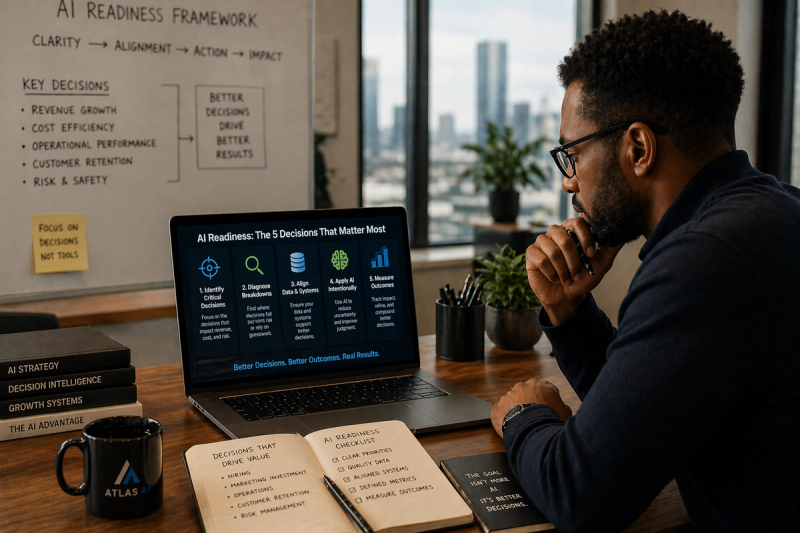
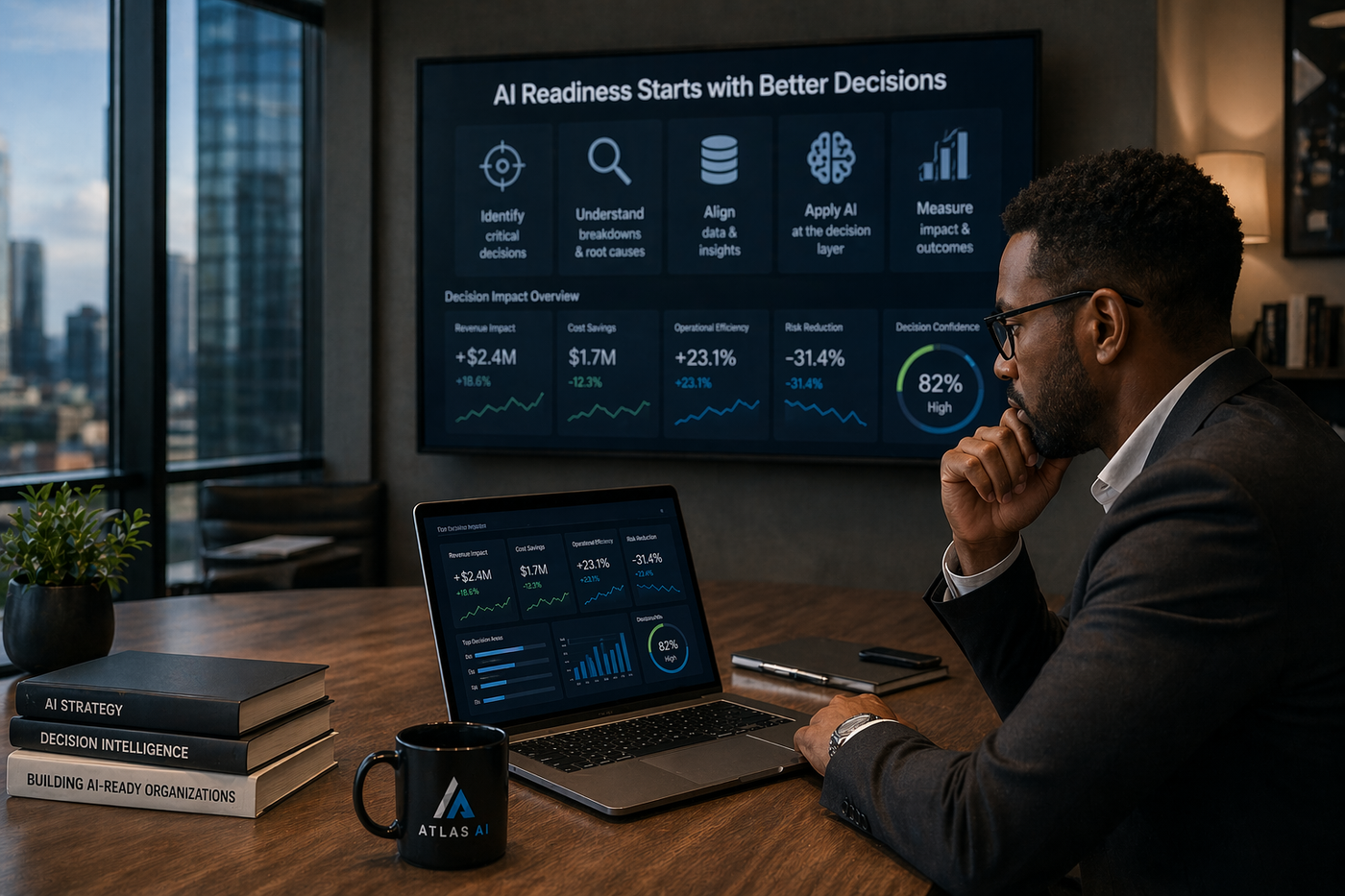
Step 1: Identify Critical Decisions
Map the decisions that directly impact revenue, cost, and growth.
If a decision does not impact outcomes, it is not a priority.
Step 2: Locate Breakdown Points
Where are decisions inconsistent, delayed, or based on guesswork?
This is where value is lost.
Step 3: Align Data to Decisions
Connect the data you already have to the decisions you need to improve.
Most organizations skip this step and go straight to tools.
Step 4: Introduce AI at the Decision Layer
Use AI to:
- Analyze patterns
- Predict outcomes
- Reduce uncertainty
Not to replace people.To support better judgment.
Step 5: Measure Decision Impact
Track how decisions improve:
- Conversion rates
- Retention
- Efficiency
- Profitability
If decisions are not improving, AI is not working.
What This Means for Your Business
AI readiness is not about how advanced your systems are.
It is about how clear your business is.
Clear on:
- What decisions matter
- Where they break
- How to improve them
The companies that understand this are not just adopting AI.
They are building a long-term advantage.
Better decisions do not just improve one outcome.
They improve everything.
Let’s Talk About Your Business
If you are trying to figure out where AI actually fits in your business, do not start with tools.
Start with your decisions.
If you want help identifying where your decisions are breaking down and how AI can improve them, we can walk through it together.
Book a strategy session:https://calendly.com/atlasaimarketing-info/30min
Explore More from Atlas AI
- Atlas AI Services: https://www.atlasaimarketing.co/services
- Atlas AI Insights: https://www.atlasaimarketing.co/insights
What the Data Shows
- McKinsey AI Report: https://www.mckinsey.com/capabilities/quantumblack/our-insights/the-state-of-ai
- MIT Sloan AI Decision-Making:https://sloanreview.mit.edu/article/intelligent-choices-reshape-decision-making-and-productivity/
- Gartner AI Value Measurement:https://www.gartner.com/en/articles/ai-value
- FreightWaves Logistics Insights: https://www.freightwaves.com/news