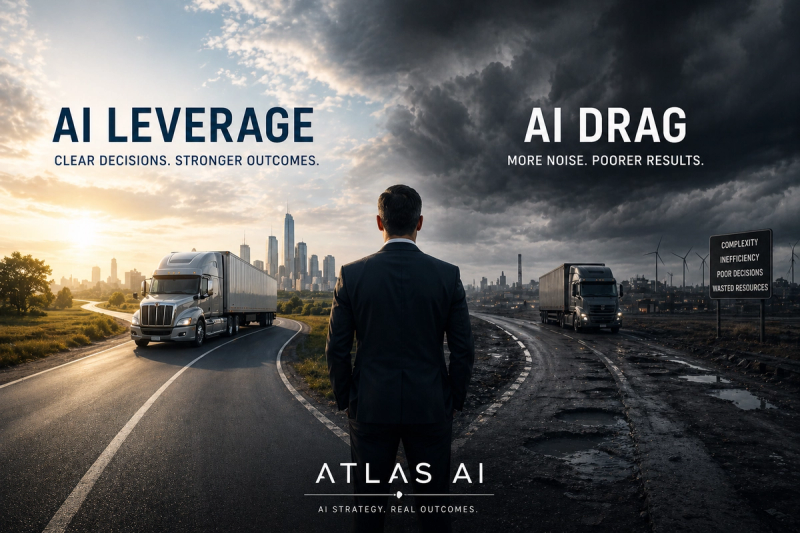
In trucking, logistics, and most service-based industries, the competition isn’t always about who’s better; it’s about who’s visible. Every day, great companies lose opportunities simply because their story never reaches the right audience.
AI is changing that.
Artificial intelligence is no longer just about automation or data; it’s about attention. It helps brands establish a consistent presence, communicate effectively, and attract clients who genuinely align with their values and goals. The companies that merge AI with authenticity are the ones building powerful, lasting brands in 2025 and beyond.
The Industry Shift/Context
For years, branding in trucking and logistics meant a logo, a tagline, and a decent website. But those days are over.
Now, the market rewards connection and consistency more than image. Buyers want proof of value, not just promises. Drivers scroll through company pages, reading posts, watching videos, and quietly deciding if the company’s voice matches what it claims.
The challenge? Many businesses sound robotic, ironically, even before they have implemented AI.
AI has entered the scene not to replace creativity but to close the gap between what a company does and how people experience it. It turns insights into communication and communication into credibility.
According to a July 2025 report by the American Trucking Associations (ATA), the driver shortage stands at an “historic high” of over 80,000 and is projected to grow to 160,000 by 2028. Those numbers don’t just signal recruiting challenges; they highlight a branding crisis. When drivers or customers can’t connect with who you are, they simply move on.
In a world flooded with noise, clarity is currency. And AI is how modern brands are earning it.
Why This Matters
Building a brand that attracts clients, not just customers, requires clarity, consistency, and trust. AI helps deliver all three.
According to Deloitte’s 2025 report on Generative AI in Marketing, organizations that integrate AI into creative and communication workflows are seeing dramatic gains in both productivity and personalization. The report highlights that marketing teams using AI-driven insights can scale storytelling, analyze engagement patterns in real time, and deliver messages that feel more relevant to their audiences, not less human.
This matters for trucking and logistics leaders because brand loyalty no longer comes from contracts; it comes from experience. AI bridges the distance between your team’s effort and your audience’s perception.
Every interaction, from a driver application email to a LinkedIn post, becomes an opportunity to reinforce your brand’s voice, tone, and reliability.
Real-World Applications
Here’s how companies in trucking, logistics, and service industries are using AI today to create brands that connect and convert.
1. Brand Voice Development through AI Tools
AI helps define, document, and strengthen your tone of voice. Tools like ChatGPT or Jasper can analyze your existing content, job posts, website copy, and even podcast transcripts to identify what resonates most.
For example, if your posts that highlight driver appreciation outperform technical updates, AI can show you why and help replicate that tone across your marketing. It’s not about changing your voice; it’s about protecting it.
Consistency builds trust, and trust builds a magnetic brand.
2. Predictive Audience Targeting
AI can identify the audiences that are most likely to engage, apply, or convert.
By analyzing engagement data from LinkedIn, website visitors, and ad performance, AI-powered systems can predict what content will work best and when to post it.
For trucking companies, this could mean targeting a specific region of owner-operators or reaching decision-makers in logistics firms looking for cross-border support. Instead of chasing everyone, you focus on the right ones.
That precision saves money and builds authority faster.
3. Automated Content Creation (with Human Oversight)
AI-generated content can help you stay visible every week without burning out your team.
Platforms like HubSpot’s Content Assistant or Notion AI help produce captions, visuals, and newsletters faster. However, the secret lies in balance: automation keeps you consistent, while humans keep you authentic.
According to HubSpot’s 2025 State of Marketing Report, over half of marketers (56%) say their companies are already using AI, and 93% use it to generate content faster. The same report highlights that AI is freeing marketers to focus on strategy and creativity, with 83% saying it helps them work more efficiently. Marketers also report higher brand awareness and stronger customer engagement as a result of AI-driven personalization and automation, confirming that the most magnetic brands are the ones using AI to stay consistently relevant across every platform.
4. Personalization at Scale
Your brand isn’t just what you post; it’s how you respond.
AI allows personalized communication at scale. From automated CRM follow-ups to chatbots that answer recruiting questions, AI helps your brand stay responsive without losing the human touch.
A driver who receives an instant, helpful answer from your chatbot feels valued. A carrier that gets an AI-personalized proposal based on previous communication feels understood.
AI doesn’t replace relationships; it strengthens them.
5. Visual Branding with AI Design Systems
AI design tools like Adobe Firefly and Midjourney enable you to maintain the sharpness and consistency of your branding, even without a full-time designer.
You can use the same color palette, phototone, and message style across your blog, website, and social media. When people recognize your brand in their feed instantly before reading your name, you’ve won the attention game.
That’s what magnetic branding looks like.
ROI & Data Insights
AI-backed branding is not a trend; it’s a measurable advantage.
Accenture’s “AI: Built to Scale” report found that fewer than 30% of companies are scaling AI effectively, often because they focus on the tech before the brand. The businesses that integrate AI with a clear brand purpose outperform others in customer satisfaction and ROI.
Data from the Content Marketing Institute’s 2025 B2B Benchmark Report shows that nearly 40% of B2B marketers have added AI for content marketing to their 2025 investment plans. The report also highlights that AI is being used most frequently for topic research, content optimization, and audience targeting, key factors in improving engagement and consistency.
For logistics and trucking companies, this translates to better-qualified leads, stronger brand recognition, and more consistent visibility without requiring additional hours.
But ROI isn’t just about clicks and conversions; it’s about reputation. AI keeps your brand showing up consistently and credibly, even when your team is stretched thin.
Challenges & Fears
Let’s be real, many leaders are hesitant to trust AI.
“What if it makes us sound fake?” That only happens when AI runs the show without human editing. Think of it as your assistant, not your replacement.
“What if people think we’re automating relationships?” They won’t know if you stay transparent about how AI helps you communicate better. Most clients and drivers appreciate quick, clear communication over delayed personal replies.
“What if it’s too complicated?” AI doesn’t have to start big. Start small. One workflow. One insight. One automation that saves you five hours a week.
And according to the World Economic Forum’s “Future of Jobs Report 2025,” creative and social intelligence skills are among the fastest-growing in the AI age. Technology is expanding opportunities for human-centered leadership, not shrinking them.
The goal isn’t to become an AI expert; it’s to use AI to amplify your expertise.
The Atlas AI Framework: Building a Magnetic Brand in 90 Days
Here’s the step-by-step process Atlas AI uses to help brands find their voice, scale their systems, and strengthen their impact.
Phase 1: Audit and Align (Weeks 1–3)
- Identify your current brand voice, visuals, and areas for improvement in engagement.
- Use AI analytics to audit audience behavior and engagement data.
- Define your message pillars and your differentiator, which makes your brand worth remembering.
Phase 2: Systemize and Scale (Weeks 4–8)
- Set up AI tools for SEO, keyword research, and content planning.
- Automate scheduling, post optimization, and engagement tracking.
- Build a cross-platform brand calendar powered by analytics, rather than assumptions.
Phase 3: Refine and Humanize (Weeks 9–12)
- Review results from your AI-driven campaigns.
- Adjust based on what’s resonating most.
- Add human storytelling, testimonials, and behind-the-scenes content to strengthen the connection.
By the end of 90 days, you don’t just have automation; you have alignment. Your message, visuals, and systems work together to attract the right clients, rather than chasing the wrong ones.
Moving Forward with AI
AI won’t replace your story; it helps the world hear it louder.
A magnetic brand isn’t built overnight or by technology alone. It’s created by leaders who understand who they are, what they stand for, and how to use the right tools to stay consistent.
In the next few years, the gap between companies that use AI strategically and those that ignore it will resemble the gap between Blockbuster and Netflix. The winners will be the ones who combined authenticity with intelligence, those who didn’t resist change but directed it.
The companies that treat AI like a teammate, not a threat, will win the attention war.
Let’s Talk Strategy
If you’re ready to see how AI can help your brand attract better clients consistently and authentically, let’s talk strategy.