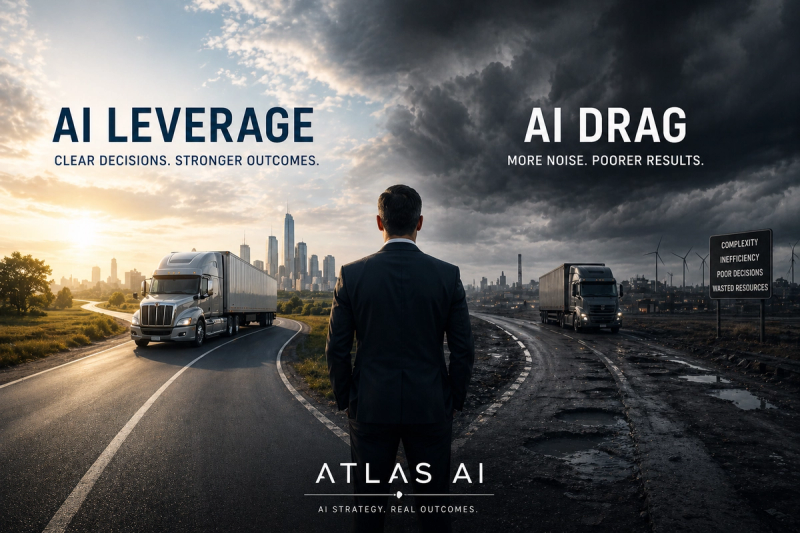
The future of marketing leadership isn’t about hiring more people; it’s about hiring smarter systems.
Today's economy forces every business leader to reconsider their approach to growth. People expect results yesterday, budgets are tighter, and timelines are shorter. The traditional marketing team, once comprised of specialists, agencies, and numerous meetings, is struggling to keep pace.
Enter the new model: the Fractional CMO powered by AI.
This evolution isn’t just about outsourcing leadership; it’s about combining strategic experience with intelligent automation. AI-driven Fractional CMOs are helping companies cut costs, scale faster, and replace bloated marketing teams with agile, data-backed systems that deliver results in real time.
The Industry Shift/Context
For decades, marketing operated on volume: more people, more ideas, more output. But now, volume doesn’t win; velocity does.
In the past, a CMO might have managed multiple teams: copywriters, designers, ad buyers, and analysts, all working in silos. Today, AI systems can do in minutes what once took those teams weeks.
Traditional CMOs were expected to “own the brand.” Modern CMOs must own the data. Instead of merely conveying narratives, they design systems that guarantee the delivery of these stories with accuracy, consistency, and quantifiable return on investment. The companies thriving right now aren’t the ones with the largest marketing departments; they’re the ones with leaders who know how to turn data into decisions faster than anyone else.
According to Accenture’s “AI: Built to Scale” report, only about a quarter of companies are successfully scaling AI across their organizations. The firms seeing the greatest impact treat AI not as a single tool, but as an integrated business capability.
Accenture notes that success depends on combining strategic vision with operational execution, building a strong data foundation, using automation for efficiency, empowering people through talent development, and applying AI responsibly. Companies that adopt this holistic, human-centered approach consistently outperform their peers in both innovation and profitability.
For marketing leaders, the same principle applies: AI alone doesn’t drive results; alignment does. The Fractional CMO 2.0 model works because it connects strategy, systems, and storytelling into one scalable ecosystem.
That’s the essence of the modern Fractional CMO: a combination of leadership experience and AI fluency.
The traditional CMO role has changed forever. What used to be a brand storyteller must now be a systems architect.
According to Deloitte’s 2025 report on Generative AI in Marketing, organizations integrating generative AI into creative and communication workflows are seeing measurable gains in productivity, personalization, and campaign performance.
The report notes that marketing and knowledge professionals using AI are saving an average of 5 to 11 hours per week, time that’s being reinvested into higher-value strategic and creative work. Deloitte also found that brands face a 54% increase in the amount of content they need to produce compared to last year, and generative AI is helping them meet that demand efficiently.
The takeaway is clear: AI is helping teams work smarter, not smaller. Instead of replacing marketers, AI gives leaders the visibility and bandwidth to focus on strategy, innovation, and long-term brand growth.
This shift matters because small and mid-sized companies can now access the same sophistication as enterprise brands without the overhead. A Fractional CMO who understands AI can plug in, assess, and build scalable systems in 90 days or less, replacing layers of staff and unnecessary agencies.
One real-world example: a logistics firm that once took six weeks to build a lead-nurturing campaign can now launch one in three days using AI tools for copy, visuals, and automation. Instead of waiting on internal bottlenecks, the Fractional CMO oversees a connected ecosystem that continuously learns and improves.
The result? Faster revenue cycles, stronger brand alignment, and less wasted time.
It’s not about replacing people; it’s about replacing inefficiency.
Real-World Applications
Here’s what AI-enabled Fractional CMOs are doing differently and why it’s changing the game for marketing teams everywhere.
1. Turning Data into Strategy
Traditional teams often spend weeks compiling performance reports before making decisions about next steps. An AI-empowered CMO doesn’t wait for reports; they act on real-time dashboards.
By integrating tools like HubSpot, Google Analytics, and ChatGPT analytics plug-ins, AI consultants can instantly identify patterns in campaign engagement, lead quality, and ROI. This shifts marketing from reactive to predictive, the foundation of modern growth.
2. Automating Execution with Precision
Where marketing teams once managed manual email sequences or ad testing, AI now automates these workflows.
A Fractional CMO utilizes tools such as Jasper for content generation, HubSpot for automated segmentation, and Zapier or Make for campaign orchestration, all of which are monitored by data dashboards that instantly flag underperformance.
This automation doesn’t eliminate creativity; it frees it. The leader can now focus on message, positioning, and strategy instead of spreadsheets and approvals.
3. Building AI-Powered Content Engines
Content remains the currency of credibility, but consistency is what compounds growth.
AI consultants utilize content-generation tools in conjunction with editorial oversight to develop what Atlas AI refers to as “Content Engines,” structured systems that generate, repurpose, and publish blogs, videos, and social posts optimized for SEO and audience engagement.
According to HubSpot’s 2025 AI in Go-To-Market Report, 73% of go-to-market professionals are now using AI tools, with marketers saving an average of 2.5 hours per day. The report highlights that AI’s biggest advantage isn’t just speed; it’s the ability to refocus human effort on strategy, creativity, and relationship-building.
4. Replacing Agencies with Systems
Agencies are expensive, and internal teams are limited by capacity. AI consultants bring hybrid solution leadership with technology.
A Fractional CMO can integrate AI for everything from audience research to paid media management. Instead of paying multiple vendors for analytics, creative, and scheduling, a single consultant can deploy an entire virtual marketing department for a fraction of the cost.
This model also brings transparency; no more waiting for monthly reports. AI dashboards offer real-time visibility of the ROI of every campaign.
5. Scaling Personalization Across Every Channel
Personalization has always been the holy grail of marketing, and now it’s finally achievable.
AI tools can create dynamic content tailored to audience behavior. Whether it’s a personalized ad creative, a follow-up email, or a lead-nurturing sequence, AI systems help companies talk to thousands of prospects as if they were one.
According to the World Economic Forum’s Future of Jobs Report 2025, AI adoption in marketing is among the top growth areas for creative and analytical professionals. That means personalization isn’t just possible; it’s now expected.
ROI & Data Insights
The ROI of AI-driven marketing leadership isn’t just about cost savings; it’s about compound performance.
McKinsey’s “State of AI 2025” found that roughly three-quarters of companies now use AI in at least one business function. Those that strategically integrate AI into marketing and sales see an average profit uplift of 3–15%, with leaders reporting 20% or higher revenue growth compared to non-adopters.
Similarly, Accenture’s AI: Built to Scale study revealed that organizations that align AI investments with business strategy achieve up to 2.5x higher return on marketing spend.
For small to mid-sized companies, the implications are clear: an AI-enabled Fractional CMO can outperform a full department while costing 70% less.
Challenges & Fears
The rise of AI consulting raises legitimate concerns for CEOs and marketing teams.
“Will AI eliminate creative jobs?” No, it eliminates repetitive ones. Creativity, storytelling, and emotional intelligence remain irreplaceable. AI amplifies human ideas; it doesn’t replace them.
“Is AI too technical for my business?” AI tools today are plug-and-play. You don’t need coding skills, just clarity on your goals. A skilled consultant configures the tools to fit your process, not the other way around.
“Can a Fractional CMO really replace my full marketing team?” Yes, in many cases, because they replace the structure, not the people. Instead of managing a dozen employees, you’re managing one experienced strategist who uses automation to scale output and insight.
The biggest barrier isn’t technology; it’s mindset. Many companies hesitate to evolve because “it’s how we’ve always done it.” Yet, according to Deloitte’s 2025 Generative AI in Marketing report, organizations with AI-literate leadership are nearly twice as likely to exceed their profitability targets. Leaders who embrace AI early are already building the competitive advantages that will define the next decade.
Change is uncomfortable, but stagnation is expensive.
The Atlas AI Playbook: How Fractional CMOs Build Smart Marketing Systems
At Atlas AI, the Fractional CMO model follows a proven 3-phase process that combines leadership, automation, and creative alignment.
Phase 1: Assess and Architect (Weeks 1–4)
- Conduct a marketing system audit to assess channels, content, and analytics gaps.
- Define growth objectives and brand voice.
- Identify AI tools that align with your industry and goals.
Phase 2: Automate and Activate (Weeks 5–8)
- Integrate automation for content scheduling, analytics, and campaign tracking.
- Build dashboards that unify marketing and sales data for live decision-making.
- Deploy pilot campaigns powered by AI personalization and performance optimization.
Phase 3: Optimize and Scale (Weeks 9–12)
- Measure performance against defined KPIs.
- Refine messaging and visuals using AI-driven insights.
- Document workflows so the system scales even without daily oversight.
Within three months, a Fractional CMO transforms your marketing from guesswork to a predictable growth engine.
The Future of Marketing Leadership
The marketing teams of tomorrow won’t be built with more people; they’ll be built with smarter systems led by agile strategists.
Fractional CMOs who understand AI represent the new standard of efficiency, blending human insight with machine intelligence to deliver faster, more consistent growth. They aren’t replacing marketing; they’re redefining it.
The Fractional CMO 2.0 era isn’t about replacing people with machines; it’s about building companies that can adapt, scale, and stay relevant long after the next trend fades. The leaders who understand the importance of balance will define the next generation of business growth.
The question isn’t whether AI will replace traditional marketing teams. It’s whether your company will be led by someone who knows how to use it.
Let’s Talk Strategy
If you’re ready to explore how a Fractional CMO with AI expertise can transform your marketing, let’s talk strategy.