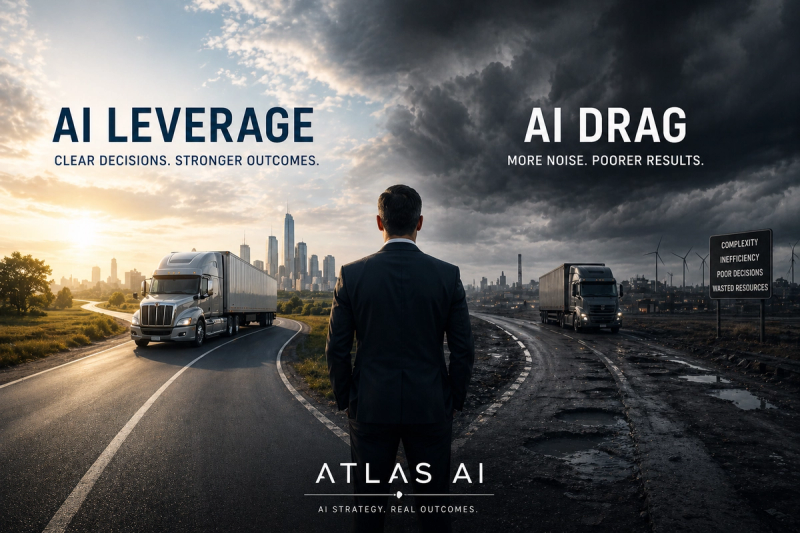
What happens when a logistics company stops guessing and starts growing with AI.
In logistics, every mile counts, and so does every lead. For one mid-sized carrier struggling to fill lanes and find qualified drivers, traditional marketing tactics weren’t cutting it. Ad spend was climbing, engagement was falling, and leads were coming in slower than shipments were moving out.
RouteOne’s marketing director described it best: “We weren’t short on effort; we were short on insight.” The team was running ads, managing social posts, and sending emails, yet everything felt disconnected. The sales pipeline looked busy, but conversions weren’t moving.
That’s when they partnered with Atlas AI to build an AI-powered marketing system that transformed how they generated and managed leads, driving a 300% increase in qualified inquiries within 90 days.
The Industry Shift/Context
The logistics industry has always relied on relationships, with brokers calling carriers, dispatchers calling drivers, and sales teams calling everyone in between. But the market has changed.
According to McKinsey’s “State of AI 2025” report, nearly three-quarters of companies now use AI in at least one business function, and those that strategically integrate it into marketing and sales are outperforming their peers in both revenue and profitability.
Unlike retail or SaaS, logistics marketing isn’t about flashy visuals or emotional storytelling; it’s about trust, timing, and capacity. Every lead represents a potential shipment or driver. That’s why AI adoption in logistics delivers an outsized ROI: it turns data into decisions faster. Predictive insights mean fewer missed bids, faster communication, and smarter recruitment advantages that directly impact the bottom line.
The company in this case study, which we’ll call RouteOne Logistics, had all the right assets: a loyal customer base, skilled recruiters, and a steady freight flow. What they lacked was a modern marketing system.
They didn’t need more recruiters or more ads; they needed clarity, automation, and a strategic approach.
Why This Matters
Most logistics firms still view marketing as an expense rather than an asset. That mindset is costing them growth.
According to Deloitte’s 2025 Generative AI in Marketing report, teams using AI tools are saving an average of 5 to 11 hours per week, which is being reinvested into higher-value, strategic work. With content demands increasing by more than 50% year over year, AI isn’t just a convenience; it’s the difference between keeping up and falling behind.
For RouteOne, that difference was dramatic. By aligning their marketing, sales, and recruiting data under one AI-powered ecosystem, they gained the insight and automation needed to scale fast.
They went from chasing leads to attracting them.
Real-World Applications
Here’s precisely how Atlas AI helped RouteOne Logistics transform its marketing and generate 300% more qualified leads in three months.
1. AI-Driven Audience Intelligence
The first step was clarity. RouteOne didn’t know which types of customers or drivers were most profitable; they just knew who had responded in the past.
Using AI analytics and CRM data, Atlas AI identified its top-performing customer profiles and most responsive driver segments. We layered that data with HubSpot insights and LinkedIn engagement metrics to map where high-quality leads were spending time online.
This allowed us to target with precision, not assumption.
2. Automated Lead Qualification
The biggest challenge was wasted time; recruiters and sales reps were manually qualifying every lead.
Atlas AI implemented automation to score leads based on engagement signals, behavior patterns, and form responses. Within weeks, RouteOne’s sales team was only contacting the top 20% of prospects, the ones statistically most likely to convert.
According to HubSpot’s 2025 AI in Go-To-Market Report, professionals using AI save an average of 2.5 hours per day and see measurable improvements in lead quality and sales alignment. RouteOne’s experience confirmed that they saved time and hit higher close rates without hiring more people.
3. Predictive Ad Optimization
Before partnering with Atlas AI, RouteOne’s ads were running on autopilot with no real optimization strategy.
We trained a predictive AI model using past ad performance and demographic data to forecast which campaigns were likely to perform best before spending a dime.
As a result, cost-per-lead dropped 42%, and click-through rates doubled within 30 days. The company reallocated the savings toward driver retention campaigns, expanding their impact beyond recruiting.
4. Personalized Content at Scale
RouteOne’s social posts and email newsletters were generic and infrequent: “We’re hiring” and “We’re growing.”
Using AI content-generation tools guided by Atlas AI’s human editorial process, the company began publishing thought-leadership pieces, driver testimonials, and case-based posts that spoke directly to their audience.
This created a consistent brand voice that was warm, credible, and authentic. Engagement jumped by 230%, and LinkedIn follower growth nearly doubled in three months.
According to the Content Marketing Institute’s 2025 B2B Benchmark Report, nearly 40% of B2B marketers have already added AI to their content marketing investments, citing improved engagement and consistency. RouteOne’s results reflected that trend perfectly.
5. Integration Between Sales and Marketing
Finally, Atlas AI connected RouteOne’s marketing automation tools to their sales CRM, creating a unified data flow between departments.
Now, when a new lead enters the system, it’s instantly categorized, scored, and routed to the right contact with real-time updates on activity and engagement.
This integration allowed RouteOne’s CMO to track ROI with precision for every campaign, click, and conversion rolled up into one dashboard.
ROI & Data Insights
Within 90 days of launch, RouteOne Logistics saw:
✅ 300% increase in qualified leads ✅ 42% reduction in cost-per-lead ✅ 230% increase in social engagement ✅ 2.5 hours saved per team member daily through automation
Before implementing AI, RouteOne averaged approximately 90 qualified leads per month at a cost of $180 per lead. By month three, they were generating 270 leads at $104 per lead, a 42% cost reduction and a 200% efficiency improvement. Those aren’t vanity metrics; they’re operational advantages that translate directly into contracts, driver sign-ons, and predictable revenue.
According to McKinsey’s “State of AI 2025,” companies that effectively scale AI are twice as likely to outperform their peers in both revenue and profitability. RouteOne’s transformation shows that even mid-sized logistics firms can achieve enterprise-level performance when AI is applied strategically.
Challenges & Fears
Every company faces hesitation when adopting AI, and RouteOne was no exception.
The team’s initial concerns included:
- Fear of job loss: “Will automation replace our recruiters?”
- Skepticism about accuracy: “Can AI really understand our market?”
- Implementation overwhelm: “How do we train people and manage tools at once?”
The hardest part wasn’t the technical setup; it was the mindset. Some team members had never used an automation platform. Others feared that AI would replace their expertise. Atlas AI led hands-on workshops where recruiters and sales reps tested new tools live. By the end of the first week, skepticism turned into curiosity. By week four, curiosity turned into confidence.
According to the World Economic Forum’s Future of Jobs Report 2025, AI adoption is reshaping every industry, but companies with AI-literate leadership are significantly more resilient and profitable.
Atlas AI’s approach focused on empowerment, not elimination. Within weeks, the culture shifted from resistance to innovation.
Framework or Playbook: The Atlas AI Logistics Growth System
Atlas AI’s Logistics Growth System is the blueprint behind RouteOne’s results. It combines automation, analytics, and brand strategy into one scalable playbook designed for logistics, transportation, and service-based businesses.
Phase 1: Assess and Architect (Weeks 1–4)
- Conduct a marketing and lead-generation audit.
- Identify data sources and gaps.
- Define KPIs, conversion goals, and customer personas.
Phase 2: Automate and Align (Weeks 5–8)
- Implement AI tools for lead scoring, content generation, and CRM integration.
- Train internal teams on new systems.
- Launch pilot campaigns using predictive and personalized content.
Phase 3: Optimize and Scale (Weeks 9–12)
- Measure performance against KPIs.
- Refine messaging and targeting using AI-driven insights.
- Document workflows for ongoing optimization and growth.
This model doesn’t just increase leads; it builds marketing systems that think, learn, and adapt.
What This Means for the Future of Logistics Marketing
RouteOne’s story proves that AI isn’t just for tech giants or billion-dollar fleets. It’s for every logistics company ready to stop guessing and start scaling.
By combining human expertise with AI-powered systems, RouteOne didn’t just generate more leads; they built a growth engine that runs with precision, purpose, and predictability.
RouteOne’s success wasn’t about technology alone; it was about leadership willing to evolve. Their CMO didn’t just adopt AI; they built a culture of continuous learning and accountability. That’s the real competitive advantage.
At Atlas AI, we believe every company, no matter its size, can achieve the same transformation when vision and innovation meet strategy.
The results weren’t a lucky break; they were a blueprint.
Let’s Build Your Case Study
If you’re ready to see how AI can multiply your leads and modernize your marketing, let’s talk.